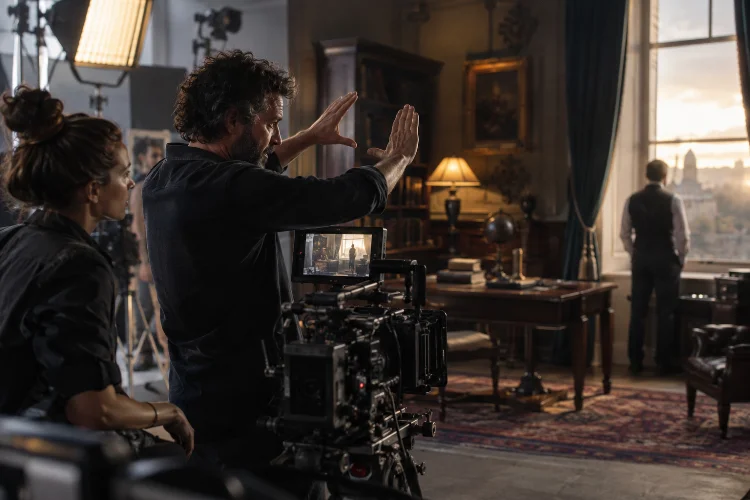
Two directors can receive exactly the same screenplay and create two completely different films.
One might shoot a family argument with handheld cameras, natural light, overlapping dialogue, and uncomfortable close-ups. Another might use symmetrical compositions, controlled performances, long static shots, and almost no background music.
The script has not changed, but the experience certainly has. That difference comes largely from the director’s interpretation of the material.
Learning how to develop a directorial vision means deciding what your film should feel like, what ideas matter most, how the audience should experience the story, and how every creative department can contribute to that goal.
A directorial vision is not simply choosing attractive camera angles or collecting beautiful reference images. It connects story, performance, cinematography, production design, editing, sound, and tone into a coherent filmmaking approach.
You also do not need to have everything figured out immediately. A strong vision often develops through reading, research, experimentation, discussion, and eventually making decisions.
Here is how to start building one.
1. Begin With What the Story Means to You
Before thinking about lenses, colors, or camera movements, ask a more basic question:
Why do you want to tell this story?
Your answer does not need to sound intellectual. Perhaps the screenplay reminds you of a relationship you once had. Maybe you are fascinated by the way ambition changes people, or you simply find the central character painfully funny.
That personal connection becomes useful because directing involves hundreds of decisions. When you understand what emotionally attracts you to the material, those decisions gain direction.
Imagine a screenplay about two brothers fighting over their late father’s house.
One director might see it primarily as a dark comedy about greed. Another may interpret it as a tragedy about childhood resentment that never disappeared.
The same scenes could therefore be performed, framed, paced, and edited very differently.
A film treatment can help clarify elements such as tone, theme, characters, visual approach, and major sequences before production begins. It can also help collaborators understand the creative direction of the project.
Your vision starts with interpretation, not equipment.
2. Define the Emotional Experience
Directors often discuss what a scene should look like, but it is equally useful to decide what the audience should feel.
Should your film feel intimate? Unpredictable? Uncomfortable? Dreamlike? Fast? Detached? Warm? Claustrophobic?
These emotional goals can guide technical choices.
Suppose you are directing a thriller about someone who believes they are being followed.
If you want the audience to share the character’s paranoia, you might frequently place unidentified people in the background, hold shots longer than expected, use reflections, and restrict how much of the enviroment viewers can see.
If you want the audience to remain objective and wonder whether the character is imagining everything, you might use calmer compositions and maintain greater visual distance.
Neither approach is automatically better.
The important thing is that your filmmaking choices support the emotional experience you are trying to create.
3. Build a Consistent Visual Language
A director does not need every shot planned before collaborating with the cinematographer, but having a visual direction makes those conversations far more productive.
Start thinking about framing, camera movement, lenses, aspect ratio, lighting, and color.
Perhaps the camera remains almost completely static during the first half of the film. As the protagonist loses control, the cinematography gradually becomes more unstable.
Maybe wide lenses dominate scenes in which a character feels free, while longer lenses become more common as pressure increases.
The idea is not to invent visual rules simply to appear artistic.
Rules are useful when they reinforce story.
Director Sean Olson, discussing Camp Hideout, described shot listing as a way of visualizing scenes, identifying transitions, and considering cinematic flow before filming.
Create References, Not Copies
Mood boards and film references are extremely helpful during pre-production.
Collect photographs, paintings, movies, architecture, fashion, textures, and lighting references that capture something about your project. You might reference one film for camera movement, another for color, and a photographer for composition.
But avoid trying to reproduce another movie exactly.
The question should not be, “How do I make this look like Blade Runner?”
A better question is, “What specifically about this reference communicates the feeling I want?”
References become useful when you can explain why you chose them.
4. Decide How Performance Fits Your Vision
A director’s style is not limited to cinematography.
Actors are often the audience’s strongest emotional connection to the story, so performance style should be part of your directorial thinking.
Does the film require naturalistic performances that feel almost documentary-like? Is the world heightened and theatrical? Should dialogue overlap? Are characters emotionally restrained or expressive?
Imagine directing a comedy.
One version might rely on energetic performances and obvious reactions. Another could ask actors to play absurd situations completely seriously, allowing the contrast to create humor.
Those approaches produce very different films even if every line of dialogue stays identical.
Talk to actors about objectives, relationships, circumstances, and behavior instead of only telling them which emotion to produce.
“Be angry” provides limited information.
“You desperately need her to admit that she lied to you” gives the performer something playable.
A clear directorial vision should guide actors without turning their performances into mechanical instructions.
5. Use Production Design to Tell the Same Story
Locations, sets, costumes, props, and colors can communicate information long before characters explain themselves.
Suppose your protagonist begins the film as a perfectionist obsessed with controlling everything.
Their apartment might initially contain precise furniture placement, carefully organized objects, and almost no visual clutter.
As their life falls apart, the production design could gradually become less controlled.
You have now turned character developement into something visible.
This is why collaboration with the production designer, costume designer, makeup department, and location team matters so much. They are not simply making the movie attractive. They are helping construct its world.
Director Michael Mann, for example, is known for treating real locations as important parts of his cinematic approach, with location texture contributing to character and atmosphere.
When discussing design choices, explain their storytelling purpose.
Instead of saying, “I want everything blue,” explain what the blue palette represents emotionally and when it should change.
6. Think About Sound Before You Start Shooting
Directorial vision is often discussed visually, which is slightly misleading.
Movies are audiovisual experiences.
Sound can completely change how an image feels.
Imagine a character walking alone through an empty office building at night. Add ominous music and viewers expect danger.
Remove the score and emphasize buzzing fluorescent lights, distant plumbing, footsteps, and air conditioning, and the same sequence may feel more realistic and unsettling.
Think about whether your film uses music frequently or sparingly.
Consider whether certain characters, places, or memories have recurring sounds associated with them. Decide when silence might be more effective than a dramatic score.
Your sound designer and composer will develop these ideas further, but involving sound in your vision early prevents it from becoming something added only after the edit is nearly finished.
Sometimes what the audience hears matters more than what they see.
7. Plan the Editing Rhythm Early
Directors do not need to edit every film themselves, but they should think about editing while planning and shooting.
A slow, observational drama needs different coverage from a fast action sequence.
Do you imagine long uninterrupted takes? Frequent cuts? Reaction shots? Abrupt transitions? Match cuts? Montages?
These decisions affect what you need to capture during production.
Olson has noted that thinking about editing during directing can reveal unnecessary shots, missing transitions, and potential story problems before post-production.
Consider a simple dinner conversation.
One director might cover it with a master shot plus conventional close-ups. Another might remain entirely in one slowly moving shot, allowing changes in actor positioning to determine where viewers look.
Both strategies can work.
The important question is whether the editing rhythm supports the emotional rhythm of the story.
Your shooting choices determine what possibilities the editor will have later.
8. Turn Your Vision Into Something the Crew Can Understand
Having ideas inside your head is not enough.
Directing is collaborative. Cinematographers, designers, actors, editors, producers, composers, and dozens of other crew members need to understand what you are trying to accomplish.
This is where a director’s treatment, lookbook, mood board, visual references, shot lists, storyboards, and director’s statement become useful.
A treatment may communicate the story, tone, visual style, themes, characters, and key sequences, helping collaborators align around the project.
But communication should not become a massive document nobody wants to read.
Keep your central ideas simple.
For example:
The camera begins controlled and distant but gradually becomes more intimate as the protagonist loses emotional control.
That single sentence could influence cinematography, blocking, lens choices, and editing.
Your crew does not necessarily need every image already designed.
They need to understand the principle behind your choices.
9. Collaborate Without Losing the Core Idea
A directorial vision does not mean refusing everyone else’s suggestions.
In fact, strong collaborators can make your original idea significantly better.
Filmmaking teams often succeed because people share compatible creative sensibilities while remaining willing to listen when they disagree.
Filmmakers Nat Faxon and Jim Rash have discussed the importance of cooperation, respect, and allowing collaborators to take the lead when someone feels strongly about an idea.
That is an important lesson for new directors.
You should know what is essential and what is flexible.
Perhaps maintaining the protagonist’s emotional isolation is essential. But whether that isolation is shown through a 50mm or 85mm lens may be something you can explore with your cinematographer.
Protect the intention, not necessarily your first solution.
Good collaboration does not weaken directorial vision.
It often makes the vision more precise.
10. Test Your Ideas Before Production
Some ideas sound wonderful in conversation and fail immediately when you put a camera in front of them.
Testing helps.
Shoot camera tests. Experiment with lighting. Try different lenses. Record costume tests. Rehearse scenes. Create rough storyboards or even film scenes on a smartphone before the actual shoot.
You may discover that the handheld style you imagined feels too chaotic.
Perhaps the color palette that looked impressive on a mood board makes skin tones look strange. Maybe the elaborate tracking shot you planned actually distracts from the actor’s performance.
Changing your mind is not failure.
A director’s vision should be clear enough to guide the film but flexible enough to improve when reality provides better information.
Documentary filmmakers Jason Sussberg and David Alvarado have described developing a stronger game plan and more deliberate creative stamp as their directorial approach expanded between projects.
Vision becomes sharper through practise.
Learning how to develop a directorial vision is not about discovering one magical visual style that you use forever. It is about learning how to interpret a story and turn that interpretation into consistent creative choices.
Start with meaning and emotion. Then explore cinematography, performance, production design, sound, and editing in ways that reinforce those ideas. Use references to communicate clearly, but do not mistake imitation for vision.
Most importantly, collaborate while protecting the central intention of the film.
For your next project, try writing one page describing what the story means to you, how the audience should feel, and three visual or sonic principles you want to follow.
Then test those ideas with a short scene. Your directorial voice becomes clearer every time you make something, review it, and decide what you would do differently next time.