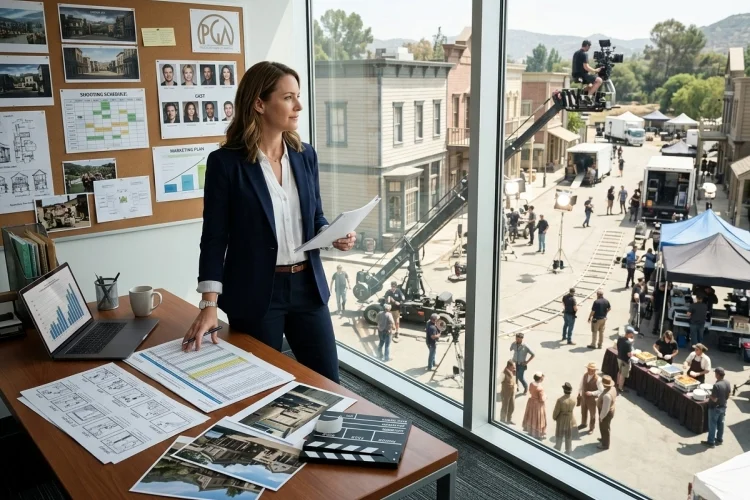
When people imagine a film set, they usually picture the director behind a monitor, actors performing, and camera crews moving equipment.
The producer may be less visible, but without one, the project might never reach the set at all. A film producer helps turn a creative idea into a practical, financed, and deliverable production.
They may find the original story, develop the screenplay, secure funding, hire key team members, approve budgets, solve major problems, and guide the project through editing, marketing, and distribution.
So, what does a film producer actually do? The exact answer depends on the production, because producer titles can cover different responsibilities. However, the primary producer is generally involved from the project’s earliest development through the delivery of the finished film.
The Producers Guild of America describes this role as making substantial decisions about creative, production, budgetary, and legal matters across development, pre-production, filming, and post-production.
In simple terms, the producer helps make sure the film can actually happen-and that it reaches completion.
The Producer Finds and Develops the Project
A producer is often one of the first people involved in a film. They may discover an original screenplay, approach a writer with an idea, acquire the rights to a novel, or begin developing a story with a director.
An interesting concept is not automatically ready for production. The producer may help the writer strengthen the structure, clarify the audience, reduce unrealistic elements, or make the project more attractive to possible financiers.
Development producers specialise in finding stories and improving them until they are strong enough to be commissioned or made into films. On smaller projects, the main producer may perform this development work personally.
The producer does not simply ask whether the story is good. They also consider whether it is practical. A script involving one house and three characters requires a very different production plan from a science-fiction adventure set across several planets.
Producers Help Secure Film Financing
Movies cost money long before the camera starts recording. Writers, casting professionals, location scouts, legal advisers, designers, and other team members may need to work during development and pre-production.
The producer creates or oversees a financing strategy. Funding may come from film institutes, studios, broadcasters, streaming companies, private investors, production companies, grants, tax incentives, or international co-production partners.
To attract support, the producer may prepare a package containing the screenplay, budget, schedule, director, lead actors, visual references, and information about the intended audience.
Securing money is not simply about finding someone willing to invest. The producer also needs to understand the conditions attached to that financing, including creative approvals, distribution rights, deadlines, and legal obligations.
According to the Producers Guild’s feature-film guidelines, producer responsibilities during development commonly include shaping the concept, securing rights and initial financing, choosing a writer, and guiding the project’s development.
The Producer Builds the Core Team
Once the project begins moving forward, the producer helps recruit the people who will make it. Key appointments may include the director, screenwriter, casting director, cinematographer, production designer, editor, and line producer.
Hiring is not only about finding talented individuals. The producer must consider whether their creative styles suit the project, whether they can work within the budget, and whether they will collaborate effectively.
For example, a director may have a brilliant visual approach but little experience managing action scenes. The producer might support them by hiring an experienced cinematographer, stunt coordinator, and assistant director.
The producer also helps establish a healthy working environment. Clear contracts, appropriate resources, safe conditions, and realistic expectations can affect both the crew’s experience and the quality of the finished film.
The BFI considers a dedicated producer essential enough that applicants to its short-film funding normally need one. It explains that separating producer and director responsibilities allows both people to focus properly on their roles and helps the project reach its creative potential.
Producers Balance Creativity With the Budget
A film producer protects the creative idea while keeping it achievable. This often means making difficult choices about where time and money should be spent.
Imagine that a screenplay includes a five-minute sequence set during a crowded music festival. Hiring hundreds of extras, performers, security teams, vehicles, and a large location may exceed the budget.
The producer does not necessarily respond by removing the scene. They may work with the director and writer to redesign it. The scene could take place behind the stage, use a smaller controlled crowd, or combine practical footage with visual effects.
A strong producer does not simply say no. They help find another route to the same dramatic result.
The approved budget also needs a contingency for unexpected costs. Weather delays, damaged equipment, location changes, illness, and additional shooting can all affect the production.
The Producer Oversees Pre-Production
Pre-production is when the creative idea becomes a detailed operational plan. The script is broken down, locations are selected, actors are cast, sets are designed, equipment is booked, and the shooting schedule is created.
The primary producer oversees major decisions, while other production professionals manage the details. A line producer typically focuses on the budget and overall logistics, while a production manager handles much of the day-to-day organisation.
The producer reviews whether the schedule is realistic and whether the available resources can deliver the director’s plan. They may also approve contracts, insurance, permits, health and safety procedures, and agreements with locations or vendors.
The Producers Guild identifies selecting key creative personnel, scouting locations, and overseeing the final screenplay, schedule, and budget as major pre-production responsibilities of the primary producer.
Good preparation reduces confusion once filming begins, when every delayed hour can become expensive.
What Does a Producer Do During Filming?
During principal photography, the producer monitors the production’s overall progress. They may not stand beside the camera for every take, but they remain responsible for major creative, financial, and operational decisions.
The producer receives updates about the shooting schedule, completed scenes, daily costs, technical problems, and possible delays. They communicate with the director, line producer, financiers, studio representatives, and other stakeholders.
Suppose bad weather prevents the crew from completing an exterior sequence. The producer may need to approve overtime, rearrange the schedule, find additional funding, or support a creative alternative.
They also help manage disagreements. A director may want more time for a performance, while the line producer warns that the production is falling behind. The producer must understand both concerns and make a decision that protects the film.
The Producers Guild describes the producer’s production-stage role as overseeing operations, resolving issues raised by creative and physical-production teams, and maintaining communication with financial and distribution partners.
The Producer Remains Involved in Post-Production
When filming ends, the producer’s job continues. Editing, visual effects, sound design, music, colour grading, titles, subtitles, and final delivery all require time, people, and money.
The producer reviews cuts with the director and editor, gives notes, and monitors whether post-production remains on schedule. They may need to decide whether a problem requires additional editing, visual effects, ADR, or reshooting.
On larger projects, a post-production producer or supervisor manages the detailed workflow. The primary producer still oversees major decisions and ensures the film satisfies its creative, financial, legal, and technical obligations.
The Producers Guild includes close involvement with post-production teams, marketing strategy, and distribution among the primary producer’s typical responsibilities.
A film is not complete simply because the edit looks good. Music rights must be cleared, credits must be checked, technical masters must be created, and all required deliverables must reach the distributor or platform.
Producers Also Think About Marketing and Distribution
A completed film has little impact when nobody knows it exists. Producers therefore begin thinking about its audience long before the final export.
A distribution strategy may involve film festivals, cinemas, television, streaming platforms, educational screenings, sales agents, or a direct online release. The best route depends on the genre, length, budget, and intended viewers.
Marketing materials can include a trailer, poster, production stills, synopsis, press kit, social content, and interviews. The producer may work with publicists, distributors, festival programmers, and sales teams to position the film effectively.
The BFI’s producer guidance includes examples covering the pitching, casting, production, and marketing of both short and feature films, demonstrating that the role extends beyond the shooting process.
This does not mean every producer personally designs posters or uploads trailers. Their responsibility is to make sure a realistic release plan exists and that the appropriate people carry it out.
Different Producer Titles Have Different Meanings
Film credits may list several kinds of producers, which can make the role confusing. The meanings can also vary between projects.
The primary producer or person receiving the main “Produced By” credit usually carries broad responsibility for developing, managing, and delivering the film. An executive producer may provide financing, influence, experience, or high-level support.
A line producer concentrates on budgets, staffing, schedules, and physical production. An associate producer supports specific producing functions, while a post-production producer oversees the workflow after filming.
The Producers Guild maintains detailed credit definitions because the word “producer” can represent many different levels and kinds of involvement.
When evaluating a producer’s work, it is therefore important to look beyond the title and understand what responsibilities they actually performed.
What Skills Does a Film Producer Need?
Producers need creativity, organisation, financial awareness, negotiation skills, leadership, and emotional intelligence. They must understand storytelling while also dealing with contracts, schedules, budgets, and competing priorities.
Problem-solving is essential because filmmaking rarely follows the original plan perfectly. A producer must respond calmly when funding changes, a location disappears, or an important crew member becomes unavailable.
Communication also matters. Producers speak with creative artists, technical crews, lawyers, accountants, investors, and distributors, each of whom may view the project from a different perspective.
For beginners, producing a small short film is one of the best ways to practise. Start with a realistic screenplay, prepare a simple budget, recruit a reliable team, schedule the shoot, and guide the project through editing and release.
The goal is not merely to organise a filming day. It is to help the entire project move from an idea to a finished film that can reach an audience.
A film producer is the person who helps transform creative ambition into a completed production.
They develop the story, secure resources, build the team, approve budgets, oversee preparation, solve problems during filming, and guide post-production, marketing, and delivery.
The job combines artistic judgement with practical responsibility. Producers protect the story, but they must also make sure the production remains legal, safe, organised, and financially achievable.
To understand producing, try managing a short film from beginning to end. Choose a simple script, calculate what it requires, create a schedule, and assemble a small team.
Taking responsibility for the entire journey will show why a producer is not simply a manager-they are one of the driving forces that allows a film to exist.