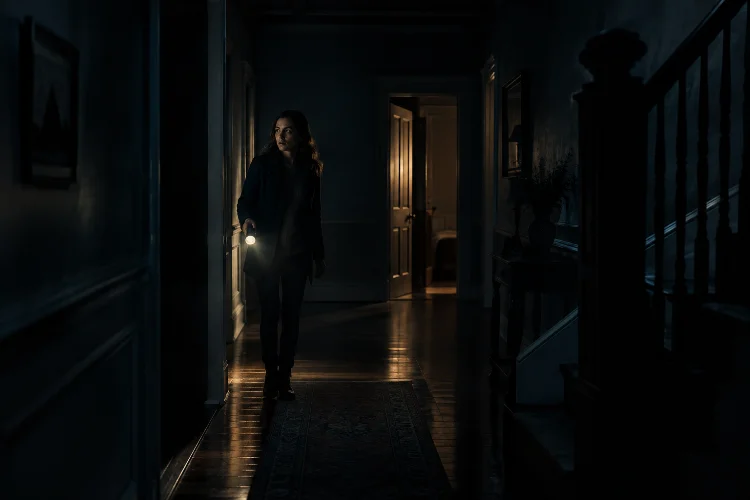
Imagine watching a character enter an empty house at night. Nobody says anything. The hallway is dark, the camera slowly moves forward, a half-open door appears in the background, and the character suddenly stops walking.
Before a single line of dialogue is spoken, you already know something is wrong.
That is visual storytelling.
Understanding how visual storytelling works in film means learning how filmmakers communicate information, emotion, character, and meaning through images rather than simply explaining everything with dialogue.
Camera position, lighting, color, movement, costumes, locations, editing, and even empty space inside the frame can tell part of the story.
Great filmmaking does not necessarily mean creating beautiful images in every shot. A visually impressive scene can still feel meaningless when its style has nothing to do with the narrative.
Instead, effective cinematic storytelling happens when visual choices have a purpose. The audience may not consciously notice every decision, but those choices influence what they understand, where they look, and how they feel.
1. Visual Storytelling Is More Than Making a Film Look Beautiful
One of the biggest misconceptions among beginner filmmakers is that visual storytelling simply means cinematography that looks impressive.
Beautiful lighting, expensive lenses, dramatic camera movement, and cinematic color grading can certainly improve a film’s appearance. But visual storytelling is really about communicating meaning through those elements.
Suppose a character feels increasingly isolated from their family. Instead of having them say, “I feel alone,” the director could gradually position the character farther away from everyone else within the frame.
The audience receives the same information, but visually.
This principle is sometimes summarized with the filmmaking idea of “show, don’t tell.” That does not mean dialogue is bad.
It means filmmakers should consider whether an image, action, expression, or visual relationship can communicate information more effectively than exposition.
Visual storytelling therefore starts with a simple question: What should the audience understand or feel from this image?
2. Composition and Framing Guide the Audience’s Attention
Every movie frame contains information. Composition determines how that information is organized.
Filmmakers can place a character in the center, push them toward one edge, surround them with objects, leave enormous negative space around them, or hide important details deep in the background.
None of those choices are automatically better than another.
For example, placing a character alone in a large frame can emphasize loneliness. Filling the frame with people and objects might instead create pressure, chaos, or claustrophobia.
Composition techniques such as symmetry, leading lines, foreground layering, negative space, and the rule of thirds can help organize an image. However, these are tools rather than strict rules.
Shot composition works especially well when it reveals relationships. Two characters standing close together may suggest intimacy. Putting a physical barrier between them—a window, doorway, wall, or piece of furniture—can visually suggest emotional distance.
This is why composition is not simply about making the frame attractive. It can reveal character, conflict, and story information without needing words.
3. Shot Size, Camera Angle, and Lenses Change Perspective
Where the camera is placed determines how viewers experience a scene.
A wide shot allows the audience to understand the surrounding enviroment and see how characters relate to it. A medium shot brings viewers closer, while a close-up can make a small facial reaction feel extremely important.
Close-ups are especially powerful because they reduce distractions and direct attention toward subtle expressions. Filmmaker Ingmar Bergman became famous for using faces and close framing to explore his characters’ emotional states.
Camera angles can also influence perception.
Looking upward at a character may emphasize dominance or importance, while looking downward may make someone appear vulnerable. These meanings are not universal rules, though. Context always matters.
Lens choice changes visual perception as well. A wide-angle lens can exaggerate depth and make distances appear greater. Longer focal lengths can compress visual space and make background elements feel closer to the subject.
The practical lesson is simple: do not choose a camera position only because it looks “cinematic.” Decide whose perspective matters and what the audience should feel.
4. Lighting and Color Create Emotional Information
Lighting is one of the fastest ways to change how an image feels.
A softly illuminated room with balanced shadows may feel peaceful and comfortable. The exact same location can feel threatening when most of it disappears into darkness and only part of a character’s face remains visible.
This is why cinematography uses lighting for much more than exposure. Light direction, contrast, intensity, and shadow can communicate atmosphere, time, emotional state, and dramatic importance.
Color works in a similar way.
A filmmaker might establish warm colors throughout scenes representing safety and introduce colder tones when a character enters an unfamiliar world. Another story could deliberately reverse those expectations.
Color palettes can also connect characters, places, or recurring ideas. Changes in saturation and brightness may visually support changes in mood or character development.
The key word is consistency.
Using red in one random shot does not automatically create symbolism. Meaning becomes stronger when a visual choice is established, repeated, contrasted, or transformed throughout the story.
5. Mise-en-Scène Tells Stories Inside the Frame
One of the most useful filmmaking concepts for understanding visual storytelling is mise-en-scène.
The term broadly refers to the elements arranged in front of the camera, including sets, props, costumes, lighting, actor placement, and visual composition.
Imagine two versions of the same character’s bedroom.
In the first version, clothes cover the floor, dishes pile up beside the bed, curtains remain closed, and unfinished work covers the desk. In another version, everything is perfectly organized, clothes are arranged by color, and every object has a precise position.
Without dialogue, you already begin forming different assumptions about the person living there.
Production design therefore becomes part of characterization.
Costumes can suggest profession, wealth, personality, transformation, or belonging. Props can reveal habits or provide information about someone’s past. Locations can communicate social class, culture, isolation, freedom, or danger.
Good visual storytelling asks whether these details contribute to the narrative instead of simply decorating the frame.
6. Camera Movement Should Have a Storytelling Purpose
Modern cameras make movement easier than ever. Gimbals, drones, sliders, handheld rigs, and stabilization software allow even small productions to create dynamic shots.
But constant movement does not automatically make a film more interesting.
A static camera can create patience, distance, awkwardness, or tension. Handheld footage may create instability or immediacy. A slow push-in can gradually increase emotional intensity, while a tracking shot can keep viewers closely connected to a moving character.
Different camera movements include pans, tilts, tracking shots, push-ins, crane movements, zooms, and handheld techniques. Each changes how viewers experience space and action.
Consider a character who has just discovered an important secret.
Immediately cutting to a dramatic close-up is one option. Another is beginning with a medium shot and slowly moving toward the character as they process the information.
The second approach creates visual progression.
The audience does not simply see emotion; the camera movement helps them enter it.
Before adding a complicated camera move, ask whether the scene would lose anything if the camera stayed still. If the answer is no, the movement may be unnecessary.
7. Editing Creates Meaning Between Images
Visual storytelling continues long after production ends.
Editing determines which image viewers see, when they see it, and how long they are allowed to look at it.
Imagine a shot of a person smiling.
By itself, the image has relatively simple meaning. Cut from that smile to a child playing nearby and the character may appear affectionate. Cut instead to a damaged car and the same smile suddenly becomes disturbing.
Meaning can therefore emerge from the relationship between seperate images.
Continuity editing usually attempts to make cuts feel smooth so viewers remain immersed in the story. Matching movement, maintaining screen direction, and keeping spatial relationships understandable help create this sense of continuous action.
But editors can intentionally break continuity as well.
Rapid cuts may create excitement or anxiety. Long takes can allow tension to develop gradually. Repetition can emphasize an idea, while sudden changes in editing rythm can signal that something important has changed.
Editing is not simply the process of removing mistakes. It is another stage of storytelling.
8. Repetition, Symbols, and Visual Motifs Add Deeper Meaning
Not every visual idea needs to communicate information immediately.
Filmmakers often repeat images, colors, objects, shapes, or compositions throughout a movie. These repeated elements are commonly called visual motifs.
Imagine that a character repeatedly looks through windows whenever they feel trapped. The first window shot may seem ordinary. After the image appears several times, viewers begin connecting windows with the character’s desire for freedom.
The filmmaker can later break that visual pattern.
Perhaps near the end, instead of looking through another window, the character finally opens a door and walks outside. The change becomes more meaningful becuase the film established a visual language earlier.
Symbolism works best when it supports the story instead of demanding attention.
Audiences do not always need to consciously identify every metaphor. Sometimes visual patterns simply create a stronger emotional impression.
This is where planning becomes valuable. Storyboards, shot lists, production design references, and color palettes allow filmmakers to develop visual ideas before arriving on set.
How Beginners Can Practice Visual Storytelling
You do not need an expensive cinema camera to practice these techniques.
Try creating a one-minute scene with no dialogue. Give the character a simple objective, such as waiting for someone who never arrives, hiding an object, or deciding whether to leave home.
Then communicate the story only through framing, performance, lighting, props, camera placement, and editing.
After editing the scene, show it to someone without explaining what happens.
Ask what they think the character wanted, what emotion they felt, and what details they noticed. If their interpretation is reasonably close to your intention, your visual choices are probably doing useful storytelling work.
This exercise is often more valuable for beginners than trying to make every shot look realy expensive.
Understanding how visual storytelling works in film changes the way you both watch and create movies. Images are not simply containers for actors and dialogue.
Framing, camera angles, lenses, lighting, color, production design, movement, and editing can all carry narrative information.
The strongest visual choices usually have a reason behind them. A close-up should direct attention somewhere important. Camera movement should change the audience’s experience. Color and production design should reinforce the world, character, or emotional journey.
You do not need complicated equipment to begin developing these skills. Pick a simple scene, remove the dialogue, and challenge yourself to communicate the story entirely through images.
Then watch your favorite films again-but this time, pay attention not only to what happens, but to how the filmmakers show it.