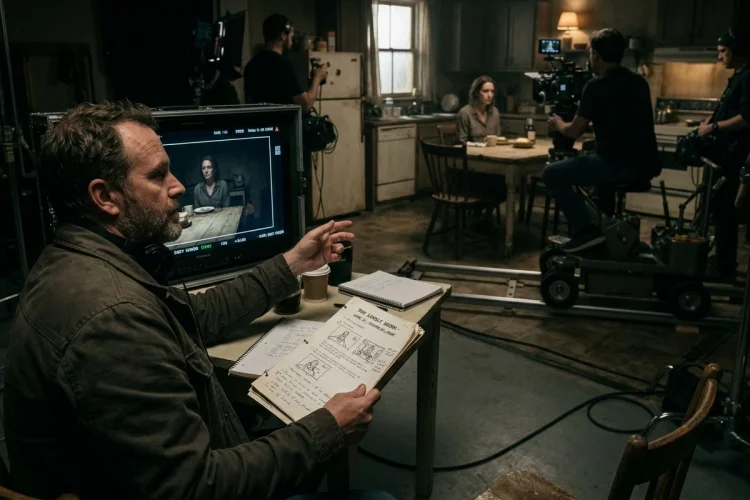
A screenplay may describe a lonely woman sitting in an empty kitchen, but it does not automatically tell us exactly how that moment should look, sound, or feel.
Should the room be brightly lit or hidden in shadow? Should the camera move closer to her, remain far away, or focus on the untouched dinner beside her?
These are the kinds of decisions a director makes when translating written material into cinema. The director takes dialogue, action, character motivation, and theme from the page and transforms them into images, performances, movement, sound, and rhythm.
Learning how directors translate scripts into visual stories is useful for anyone interested in filmmaking. It reveals why two directors could work from the same screenplay and produce completely different movies.
The process involves more than choosing attractive shots. Directors must understand the emotional purpose of each scene, communicate that vision to actors and department heads, and make sure every creative element supports the same story.
ScreenSkills describes this visual interpretation of the screenplay as one of the director’s central responsibilities.
Directors Begin by Finding the Story Beneath the Plot
Before planning camera angles, a director needs to understand what the screenplay is really about. The plot explains what happens, while the deeper story explores why those events matter emotionally.
Imagine a script about a young boxer preparing for a championship fight. On the surface, it is a sports story. However, the director may decide that its emotional centre is the boxer’s fear of disappointing her father.
That interpretation affects every later choice. Training scenes may focus less on physical strength and more on the character constantly looking towards her father for approval.
The final fight may become important not because of the trophy, but because she must choose whether to follow his instructions or trust herself.
Directors commonly break down scripts scene by scene, identifying character objectives, emotional changes, conflict, turning points, and important visual details. This analysis gives the production a consistent dramatic direction.
They Decide What the Audience Should Feel
A director does not simply ask, “What happens in this scene?” They also ask, “What should the audience feel while watching it?”
A scene in which a man enters an unfamiliar house could feel romantic, mysterious, funny, or frightening. The basic action remains the same, but lighting, performance, framing, sound, and editing can completely change its effect.
Suppose the scene is meant to create suspense. The director might delay revealing the entire room, keep part of the frame hidden, and use quiet background sounds.
If the same moment is intended as comedy, the camera may reveal an embarrassing surprise before the character notices it.
Defining the emotional purpose helps the director make focused choices. Without it, the camera, actors, music, and production design may appear to belong to different films.
Script Descriptions Become Visual Plans
Screenplays usually provide essential action and setting, but directors must decide how those details will appear on screen. They may create storyboards, shot lists, mood boards, floor plans, or collections of visual references.
A line such as “Daniel realises that his friend has betrayed him” cannot simply be photographed. The director has to turn that internal realisation into something visible.
Perhaps Daniel notices a familiar ring on the villain’s desk. The camera moves from the ring to his face, and his expression changes. No dialogue is necessary because the image allows the audience to make the discovery with him.
Choosing What to Show
Visual storytelling often depends on controlling information. A director decides what the audience sees, when they see it, and whose perspective shapes the moment.
Showing a dangerous figure behind a character creates suspense because viewers know something the character does not. Hiding the figure until the character turns around creates surprise instead.
These decisions guide attention and influence emotion. Adobe’s cinematography guidance notes that composition, camera angles, and framing affect how viewers understand characters, plot developments, mood, and tension.
Camera Choices Express Meaning
Directors work closely with cinematographers to choose shot sizes, lenses, angles, lighting, and camera movement. These choices should communicate the story rather than simply make the film look stylish.
A wide shot may make someone seem lonely within a large environment. A close-up can draw attention to a small emotional reaction. A low angle may give a character authority, while an unusually high angle can make that person appear vulnerable.
Camera movement also changes the audience’s relationship with a scene. Slowly moving towards a character can increase emotional intensity.
Following someone through a crowded space may create energy, while keeping the camera completely still may make an uncomfortable conversation feel inescapable.
Adobe explains that camera movement affects pacing, atmosphere, and the viewer’s emotional connection to a moment.
However, there is no visual rule that works for every scene. A close-up is not automatically emotional, and a moving camera is not automatically exciting. The choice becomes meaningful only when it supports the character and dramatic situation.
Blocking Turns Dialogue Into Physical Action
Blocking refers to where actors move, stand, sit, and interact within a scene. Directors use it to reveal relationships, power, tension, and emotional change.
Consider a scene in which two sisters argue in a kitchen. If they stand face to face, the conflict feels direct. If one keeps washing dishes and refuses to turn around, her avoidance becomes part of the story.
Distance can also communicate relationships. Two characters beginning a scene on opposite sides of a room may gradually move closer as they become honest with each other. Alternatively, someone may step away at the exact moment another character reveals a painful secret.
Good blocking often feels natural, but it is carefully connected to character motivation. Actors should move because they want something, react to something, or experience a change—not merely because the shot needs more activity.
The director may adjust the camera after watching the actors rehearse. Some filmmakers design shots in advance, while others prefer to discover camera placement after seeing how performances develop. The final method depends on the director, scene, schedule, and production style.
Actors Bring the Written Characters to Life
A screenplay gives actors dialogue and actions, but directors help them understand what their characters want beneath the words.
For example, a character may say, “I’m happy for you,” while actually feeling jealous. The director might ask the actor to hide that jealousy rather than perform it openly. That creates tension between the spoken line and the visible behaviour.
Useful direction is usually active and specific. Instead of saying, “Be sadder,” a director might say, “Convince her that you are fine because you do not want her to stay.” This gives the performer something playable.
Directors also help maintain the character’s emotional journey when scenes are filmed out of story order. An actor may record the ending before shooting an earlier confrontation, so both actor and director need a clear understanding of where the character is emotionally at each point.
Performance is one of the most powerful tools in visual storytelling. A pause, glance, posture, or unfinished sentence can communicate information that would feel unnatural if explained directly.
Production Design Creates the Story’s Physical World
The director collaborates with the production designer, costume department, makeup team, and other visual artists to turn written locations and characters into a believable world.
Production design includes sets, locations, furniture, colour, objects, texture, and architectural details.
ScreenSkills explains that production designers begin with the script and work with the director and cinematographer to imagine its mood, atmosphere, lighting, composition, colour, and texture.
A wealthy character’s home, for instance, does not have to look warm or comfortable. The director and designer might fill it with expensive but impersonal objects to suggest emotional emptiness.
Costumes provide similar information. A character may wear carefully controlled clothing at the beginning of the film and gradually adopt a looser appearance as their life changes.
Props can also become storytelling devices. A cracked photograph, an unused second toothbrush, or a repeatedly repaired watch may reveal history without requiring a speech.
Sound Adds Information Beyond the Image
Visual storytelling does not mean that pictures work alone. Sound, silence, dialogue, atmosphere, and music all influence how images are interpreted.
A peaceful shot of an empty playground can feel nostalgic when accompanied by distant laughter. The same image becomes unsettling when the laughter suddenly stops.
Directors consider which sounds belong naturally in the environment and which should receive special attention. A ticking clock may become louder as a deadline approaches, while complete silence may draw attention to a character’s shock.
Music can strengthen emotion, create contrast, or connect different scenes. However, directors must avoid using it simply to tell viewers what to feel. The strongest choices usually support emotions already present in the performances and images.
Sound planning may begin before filming because certain scenes require clean dialogue, specific background recordings, playback music, or carefully timed actions.
Editing Gives the Visual Story Its Final Rhythm
The screenplay establishes a narrative order, but the editing room determines the precise timing of the finished film. Directors work with editors to select performances, arrange shots, remove unnecessary material, and control pacing.
ScreenSkills notes that directors and editors collaborate during post-production to refine the assembled footage towards a director’s cut and picture lock.
An editor may hold on an actor’s reaction instead of cutting immediately to the next line. That extra second can create suspicion, sadness, or humour.
A director may also discover that a scene works better without dialogue or that two separate moments become more powerful when placed next to each other.
Post-production combines editing with sound, music, colour, graphics, and visual effects. These elements help turn footage recorded across different days and locations into a unified screen experience.
Editing is therefore not just the final technical step. It is where many visual storytelling decisions are tested, refined, or completely reinvented.
Directors translate scripts into visual stories by identifying the emotional meaning beneath the plot and expressing it through performance, blocking, camera work, production design, sound, and editing.
Every choice shapes how the audience understands the characters and experiences the story. A camera angle can reveal vulnerability, a prop can suggest a hidden past, and a pause between lines can communicate more than a long explanation.
To practise this process, choose one short screenplay scene and imagine three different ways to direct it. Change the tone, camera position, actor movement, or setting while keeping the dialogue the same.
This exercise will show how written words are only the beginning-and how directorial choices transform them into cinema.