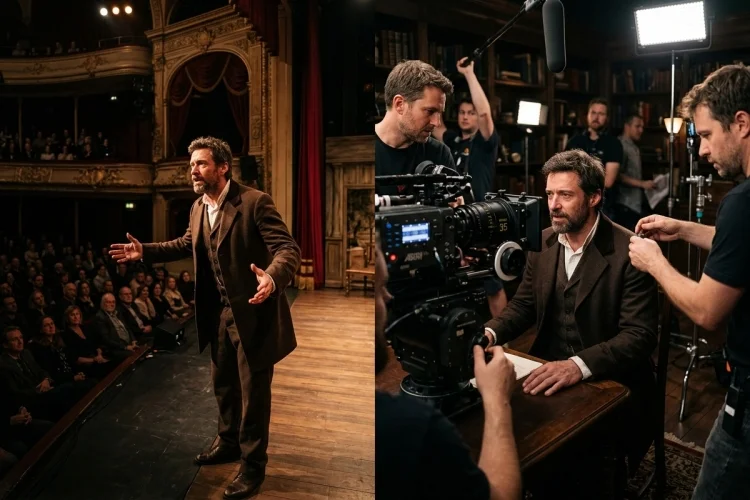
An actor steps onto a theatre stage and delivers an emotional confession to hundreds of people. The following day, the same actor performs that scene for a camera positioned less than a metre away.
The words may be identical, but the performance cannot be exactly the same. Film acting and stage acting share the same foundation.
In both forms, performers must understand character, pursue objectives, listen to scene partners, and communicate believable emotions. The major differences come from how each performance reaches its audience.
Stage actors perform live in a shared space, often projecting their voices and physical choices across a large auditorium. Film actors perform for a camera that can capture a tiny eye movement, a quiet breath, or a brief moment of uncertainty.
Understanding how film acting differs from stage acting helps performers adjust their technique without treating either form as superior.
Theatre demands energy, consistency, and live responsiveness, while screen work requires precision, continuity, camera awareness, and the ability to repeat truthful moments across multiple takes.
Film Acting and Stage Acting Use Different Performance Scales
The most obvious difference is the size of the performance. On stage, actors must communicate with audience members sitting both near the front and at the back of the theatre.
This usually requires clear physical expression, purposeful movement, and enough vocal energy to fill the performance space. That does not mean stage acting should always be exaggerated. It means the choices must remain readable from a distance.
A film camera can move extremely close to an actor. In a close-up, a small change in breathing or focus may communicate more than a large gesture.
Alfred Hitchcock once observed that a close-up can give a performer emphasis without requiring them to raise their voice or make an obviously dramatic movement.
Imagine a character hearing that a loved one has died. On stage, the actor may need to make the emotional change visible through posture, voice, and movement. On film, the director might hold a close-up while the actor remains almost still.
The emotion can be equally powerful in both versions. The scale of expression simply changes according to the audience’s distance.
Stage Actors Project While Film Actors Work With Microphones
Theatre performers often train extensively in breath control, articulation, resonance, and voice projection. They need to reach the audience clearly without damaging their voices.
Projection is not the same as shouting. It involves using breath, posture, resonance, and clear speech so the voice travels efficiently through the room. National Theatre educational guidance similarly distinguishes proper projection from simply increasing volume.
Film actors usually work with boom microphones or small radio microphones placed close to the body. This allows them to speak more quietly and use conversational vocal detail.
However, screen acting still requires strong vocal technique. An actor must remain understandable while whispering, crying, running, eating, or turning away from the microphone. Quiet acting is not careless mumbling.
The best performers adjust their volume without losing intention. A theatre actor may send a secret across a large room, while a film actor may speak it as though only the person beside them can hear.
The Camera Notices Tiny Details
The camera is extremely sensitive to behaviour. It records tension in the jaw, nervous blinking, forced smiles, and moments when an actor stops listening.
This is why screen performances often feel more internal. Instead of demonstrating an emotion, film actors usually focus on the character’s objective and allow thoughts to influence subtle physical behaviour.
Trying to “look sad” can appear artificial in a close-up. It is often more convincing for the actor to concentrate on hiding sadness, changing the subject, or preventing another character from leaving.
Camera distance also matters. A performance suitable for a wide shot may need adjustment when the director moves to a close-up. Large movements that worked in the wider frame can become distracting when only the actor’s face is visible.
RADA’s acting-for-camera training highlights truthful engagement, active listening, and staying present through multiple takes as important screen skills.
Theatre Performances Usually Follow the Story in Order
A stage play generally unfolds from beginning to end in front of a live audience. Actors experience the character’s journey in sequence and can build emotional momentum throughout the performance.
Films are normally shot according to practical needs rather than story order. Scenes may be grouped by location, actor availability, lighting, weather, or budget. ScreenSkills notes that film and television drama are commonly filmed out of sequence.
An actor might film the final emotional breakdown on Monday and the character’s cheerful introduction on Tuesday. They must understand exactly where the character is emotionally in each scene.
This requires careful script analysis. Screen performers often create notes about what has just happened, what the character currently knows, and how relationships have changed.
On stage, emotional continuity develops naturally during the live performance. On film, the actor must reconstruct it scene by scene.
Film Actors Must Maintain Physical Continuity
A screen performance is assembled from different shots and takes. The editor may cut between a wide shot recorded in the morning and a close-up filmed several hours later.
The actor therefore needs to repeat important physical actions consistently. If they lift a cup before saying a line in one shot, they may need to repeat that timing in every angle.
Continuity also includes posture, eyeline, walking speed, emotional intensity, and the position of props. Small differences can create awkward cuts or limit the editor’s choices.
This does not mean film acting should become mechanical. The challenge is to repeat the technical structure while keeping the emotional response alive.
For example, an actor may always cross the room on the same line but react slightly differently to their scene partner in each take. Good screen acting balances accuracy with spontaneity.
Stage actors also repeat blocking each night, but each performance continues without editing. A minor difference does not have to match footage recorded earlier.
Theatre Offers More Rehearsal, While Film Often Offers More Takes
Stage productions may rehearse for several weeks before opening. The cast explores the script, blocking, movement, relationships, rhythm, and use of the performance space.
Once the production opens, actors perform the complete play live. There is no opportunity to stop and repeat a scene because one line felt weak.
Film schedules work differently. Rehearsal time may be limited, particularly on smaller productions. Actors may practise briefly on set while the crew checks movement, camera placement, focus, lighting, and sound.
The scene can then be filmed several times. Multiple takes allow the director to adjust performance, framing, pacing, or technical details. RADA specifically teaches performers techniques for remaining present during repeated takes, reflecting this central challenge of screen work.
More takes do not necessarily make film acting easier. The actor may need to reproduce an intense emotional state repeatedly while equipment is adjusted and the scene is broken into separate angles.
The Audience Relationship Is Different
Theatre actors and audiences occupy the same physical space. Performers can feel the room’s concentration, laughter, silence, restlessness, and energy.
No two live performances are exactly identical. A pause may become longer because the audience is laughing, or a quiet moment may gain unusual intensity because the room is completely still.
Film actors do not receive an immediate response from the final audience. During a take, they may perform in front of cameras, lights, crew members, screens, and equipment.
Their main connection is usually with the other actors, the director, and the imagined circumstances of the scene. The audience relationship is created later through framing, editing, sound, and music.
Stage actors must sustain the audience’s attention in real time. Screen actors provide pieces of a performance that filmmakers later shape into a finished sequence.
Camera Awareness Requires Technical Precision
Film actors need to understand how their behaviour relates to the camera without appearing aware of it. They may need to hit a floor mark, maintain an eyeline beside the lens, remain inside the light, and avoid blocking another performer.
Eyelines are particularly important. Looking only a few centimetres too far in one direction can make it appear that two characters are not looking at each other.
Actors are usually told whether the shot is wide, medium, or close. This information helps them adjust movement and expression while keeping the performance truthful.
For self-tapes, RADA advises performers to direct their attention slightly beside the camera rather than looking directly into the lens, unless direct address is required.
Stage acting has its own spatial demands. Performers must understand blocking, sightlines, audience position, set changes, entrances, and exits. On a thrust stage, for example, the audience may sit on three sides, requiring actors to share the performance across several viewing angles.
Both forms require technical awareness. The difference lies in what the actor must remain aware of.
Neither Style Is More Truthful Than the Other
Film acting is sometimes described as natural, while theatre acting is labelled exaggerated. This comparison is too simple.
A realistic stage production may use restrained performances, particularly in an intimate theatre. A stylised film may require large expressions, direct address, physical comedy, or deliberately theatrical behaviour.
The correct technique depends on genre, directing style, location, camera distance, and the world of the story. A broad comedy needs different choices from a quiet family drama, regardless of whether it appears on stage or screen.
Actors who work in both forms do not abandon one technique for another. They adjust voice, movement, timing, and intensity while maintaining the same core skills.
RADA’s broader actor training combines movement, voice, speech, scene study, and acting for camera rather than treating them as unrelated disciplines.
How Actors Can Practise Both Styles
Choose a short monologue and perform it as though you are in a large theatre. Focus on clear physical choices, vocal support, and communicating across the room.
Next, record the same text in a medium shot. Reduce unnecessary gestures and imagine speaking to one person standing beside the camera.
Finally, record a close-up. Do not try to make your face interesting. Concentrate on the character’s goal, listen to the imagined response, and allow the camera to observe your thoughts.
Watch all three versions without judging which is “better.” Notice which choices remain effective and which need to change when the audience moves closer.
This exercise teaches a central lesson: the character’s truth can remain the same even when the performance scale changes.
Film acting differs from stage acting mainly because the performance reaches the audience through a different medium. Theatre actors work live, project across a shared space, and experience the story in sequence.
Film actors work through camera framing, microphones, multiple takes, technical marks, and scenes recorded out of order. Both forms demand imagination, preparation, listening, discipline, and emotional honesty.
Neither is easier, and neither should be reduced to a simple choice between “big” and “small” acting. To develop flexibility, practise the same scene for both formats.
Adjust your voice, movement, eyeline, and level of expression while protecting the character’s objective. Learning to adapt without losing authenticity is what allows an actor to move confidently between stage and screen.