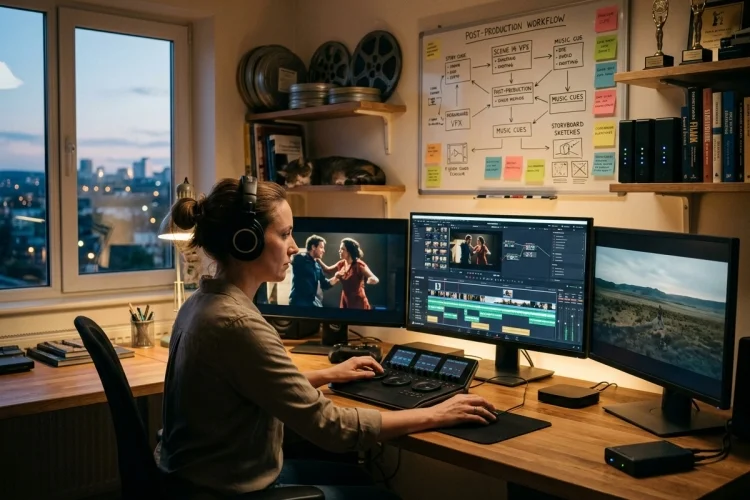
A film crew may record dozens of takes, several camera angles, separate audio tracks, and hours of material that will never appear in the finished movie. Somehow, all those disconnected pieces must become one clear and emotionally engaging story.
That is where the film editor comes in.
A film editor selects, arranges, shortens, and combines footage to create the version audiences eventually watch. The job involves much more than removing mistakes or placing scenes in the correct order.
Editors shape performances, control pacing, reveal information, build tension, and decide how long viewers experience each moment.
They also work closely with directors, assistant editors, sound teams, composers, visual-effects artists, and colourists throughout post-production. American Cinema Editors describes editing as a craft that shapes story, performance, rhythm, and emotion.
So, what does a film editor do from the first day of work to the final cut? Here is a beginner-friendly look at one of filmmaking’s most important-and often least visible-creative roles.
A Film Editor Is a Visual Storyteller
The editor’s main responsibility is turning recorded material into a coherent screen story. They decide which shots to use, where each scene should begin and end, and how one moment should lead into the next.
A screenplay provides the original structure, but the filmed material may behave differently. A scene that felt essential on the page might seem repetitive on screen. Another moment may become surprisingly powerful because of an actor’s reaction.
Editors must therefore understand character, conflict, theme, and narrative structure. They ask whether the audience understands what is happening, cares about the characters, and receives information at the right time.
In a documentary, this storytelling role can become even larger because there may be no fixed screenplay. The editor may search through hundreds of hours of footage to discover characters, themes, turning points, and a workable narrative.
The BFI notes that documentary editors often help find the story’s structure within the raw material.
The Editing Process Can Begin During Filming
Film editing does not always wait until principal photography has ended. On many productions, the editing team begins receiving material while the crew is still shooting.
Assistant editors organise the video and sound files, create backups, label clips, synchronise dialogue, and prepare the footage for the editor. They may also arrange scenes by shooting day, camera, take number, or script order.
The editor can then begin assembling completed scenes. This early work helps the director and producers see whether the footage is working.
For example, the editor may discover that a conversation lacks a clear reaction shot or that an important action is difficult to understand. When filming is still underway, the production may be able to record an additional angle or insert shot.
Editors also study reports from the script supervisor. These notes identify preferred takes, continuity details, lens information, dialogue changes, and possible technical problems.
Editors Organise and Review the Raw Footage
Before making major creative decisions, an editor needs to understand the available material. This means watching the takes carefully rather than relying only on notes from the set.
One take may contain the strongest emotional performance, while another has cleaner movement or more useful timing. The editor may eventually combine different parts of several takes into one seamless scene.
Organisation is essential because a feature film can generate a huge number of files. Poorly labelled footage wastes time and increases the risk of overlooking valuable material.
Editors often create markers, notes, selects sequences, or collections of their preferred moments. They may separate strong performances, useful reactions, establishing shots, close-ups, and cutaways.
This preparation makes the creative process faster. Instead of searching through every file whenever a problem appears, the editor already knows which alternatives are available.
The Assembly Cut Reveals What Was Actually Filmed
One of the first major versions is commonly called an assembly cut. It places the recorded scenes together in approximately the order presented by the screenplay.
The assembly is usually long and rough. It may contain repeated actions, temporary sound, incomplete effects, and scenes that have not yet found their ideal rhythm.
Its purpose is not to look polished. It allows the filmmaking team to see what material exists and whether the overall story can be understood.
The editor then begins refining the assembly into a rough cut. Adobe describes the rough cut as an early version containing the key scenes in approximate order, before final sound, music, transitions, and effects have been completed.
Watching this version can reveal slow sections, missing information, confusing character motivations, or unnecessary subplots. It may also show that certain scenes work better in a different order.
Editors Shape an Actor’s Performance
A screen performance is not created by the actor alone. It is partly built in the editing room from different takes, angles, pauses, and reactions.
Suppose an actor gives an emotional line in one take but delivers a stronger reaction in another. The editor may combine those moments so the finished scene contains the best parts of both performances.
Editors also decide when to show the person speaking and when to show the listener. Sometimes a silent reaction communicates more than the dialogue itself.
Timing Can Change the Meaning
A pause lasting two seconds may suggest uncertainty. Extending it to four seconds could create suspicion, sadness, discomfort, or comedy.
Similarly, cutting away from a face too early can weaken an emotional moment. Staying too long may make the scene feel slow or overly dramatic.
Editors must be sensitive to small changes in expression, body language, breathing, and vocal rhythm. Their choices should protect the actor’s work while helping the performance fit the wider story.
The result should feel natural even when it has been assembled from footage recorded at different times.
Editing Controls Pacing and Emotion
Pacing is not simply about making a film fast. It is about controlling how long audiences need to absorb information, experience emotion, or anticipate what will happen next.
An action sequence may use short shots and frequent cuts to create urgency. A quiet drama might stay on a character’s face, allowing the audience to notice a gradual emotional change.
Editors also create contrast. A noisy, rapidly cut sequence may feel more intense when it follows a slow and quiet scene.
The rhythm can come from dialogue, actor movement, camera movement, sound effects, or music. Editors listen as carefully as they watch because visual and audio timing are closely connected.
A cut can also guide attention. Showing a locked door after a character hears a noise encourages viewers to connect the two details. Reversing that order may create a different expectation.
Good pacing feels appropriate to the story rather than mechanically quick or slow.
The Editor Collaborates Closely With the Director
Editors usually work with directors to develop the finished version of the film. The director brings their understanding of the screenplay, performances, and production experience, while the editor provides a fresh view of the recorded material.
This distance is useful. The director may remember how difficult or expensive a scene was to shoot, but the editor can judge whether it actually helps the film.
The two may experiment with alternative performances, scene orders, transitions, or endings. Some ideas work immediately, while others must be tested before their weaknesses become clear.
Productive collaboration requires honesty and patience. An editor should be able to explain why a scene feels slow or confusing without ignoring the director’s creative intention.
The BFI’s career guidance highlights teamwork as an important part of professional editing. Editors collaborate not only with directors but also with producers, assistants, and the wider post-production team.
Editors Help Coordinate Post-Production
When the main structure is working, the film moves through increasingly detailed versions. Temporary music, basic effects, and rough sound may be added so the team can better understand the intended experience.
The editor also communicates with visual-effects teams. Placeholder shots may be inserted while finished effects are still being created.
Once major picture changes have ended, the production reaches picture lock. This means the timing and order of the images should no longer change significantly.
The locked edit is then prepared for sound editing, dialogue work, Foley, music, colour grading, titles, and final visual effects. Adobe explains that post-production brings together footage, sound, effects, colour, and other elements to create the completed film.
The film editor may continue reviewing these elements to ensure they remain synchronised with the picture and support the established rhythm.
What Skills Does a Film Editor Need?
Editing software is important, but technical knowledge alone does not make someone a strong editor. Storytelling judgement, patience, communication, and attention to detail matter just as much.
Editors need to recognise believable performances and understand how images affect one another. They must also remain organised while managing large amounts of footage and many revised versions.
Problem-solving is another essential skill. A scene may lack the ideal angle, contain continuity errors, or feel emotionally unclear. The editor must find a convincing solution using the available material.
Editors also need the confidence to remove work they like. A beautifully performed scene may still need to be shortened or deleted when it interrupts the story.
American Cinema Editors provides educational material covering editing history, theory, storytelling, cutting techniques, documentary editing, and assistant-editor workflows, reflecting the wide range of skills involved in the profession.
How Beginners Can Practise Film Editing
Start by recording one simple activity from several angles. You could film someone entering a room, sitting at a desk, reading a message, and leaving.
Capture a wide shot, medium shot, close-ups, reactions, and details such as the phone or door handle. Then edit the same footage into two different versions.
Make the first version calm and reflective. Make the second feel tense or mysterious by changing shot order, duration, sound, and the timing of information.
The footage remains identical, but the audience’s interpretation will change. This exercise demonstrates that editing is not simply about joining clips-it is about deciding how viewers experience the story.
A film editor transforms raw footage into a structured and emotionally engaging movie. They organise material, build early cuts, shape performances, control pacing, solve story problems, and collaborate with directors throughout post-production.
Their work is often invisible because effective editing allows the audience to concentrate on the characters rather than the cuts. However, nearly every moment viewers experience has been influenced by an editorial decision.
To understand the role, record a short scene from several angles and create two contrasting edits. Experiment with reactions, pauses, shot order, and sound. The exercise will show you how an editor can change meaning and emotion without recording a single new line of dialogue.