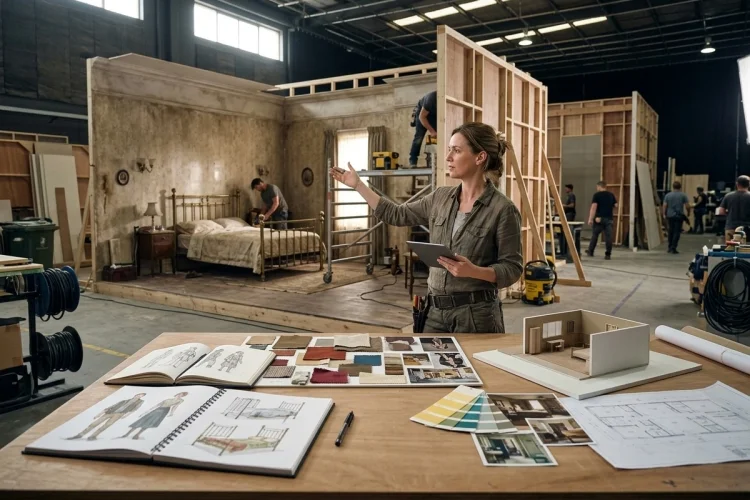
A character walks into a bedroom, and before they speak, you already understand something about them.
The room may be perfectly organised, crowded with unfinished projects, decorated with expensive objects, or filled with photographs from a life they cannot leave behind.
That information is rarely accidental. It is usually shaped by the production designer, the creative leader responsible for developing the physical world of a film or television production.
So, what does a production designer do? They interpret the screenplay, research the setting, design sets, guide location choices, establish colour and texture, and lead the art department.
They also collaborate with the director and cinematographer while working within limits involving money, time, construction, and shooting schedules.
The role combines imagination with practical management. A successful design must look convincing on camera, support the actors, express the story, and remain achievable for the production.
The Production Designer Creates the Film’s Visual World
The production designer is responsible for the overall appearance, atmosphere, and physical environment of the story. This can include sets, locations, architecture, colour palettes, props, graphics, furniture, surfaces, and materials.
The Art Directors Guild describes production designers as the people who develop the overall look, atmosphere, and emotion of a production. They communicate with directors, producers, cinematographers, visual-effects teams, prop departments, and set decorators.
This work is broader than simply making a room look attractive. A designer asks what kind of world the characters inhabit, how that environment affects them, and what viewers should understand from seeing it.
For example, a wealthy family’s home could feel warm and lived-in or cold and museum-like. Both choices communicate money, but they create very different impressions of the people living there.
The Work Starts With the Screenplay
Before choosing furniture or drawing a set, the production designer studies the screenplay. They identify locations, periods, props, vehicles, weather conditions, practical effects, construction needs, and visual changes throughout the story.
Production designer Jess Gonchor explained that his process begins with reading the script several times, making notes, developing his own ideas, and then discussing those ideas with the directors and director of photography.
The designer also looks for the emotional meaning beneath the plot. A screenplay may say that a couple lives in a small apartment, but the design can reveal whose taste dominates, how long they have lived there, what they can afford, and whether their relationship feels stable.
Translating Themes Into Design
Imagine a film about someone gradually losing control of their life. The first scenes might use orderly rooms, clean lines, and carefully arranged furniture.
As the character’s situation deteriorates, unfinished repairs, conflicting colours, discarded objects, and increasing clutter could enter the frame. The environment quietly supports the character arc without requiring additional dialogue.
Research Makes the Setting Believable
Research is especially important for historical, cultural, professional, or highly specialised settings. Designers may study architecture, interior design, social history, technology, advertising, regional materials, and everyday domestic objects.
The Art Directors Guild’s Production Design Initiative identifies research, script interpretation, visual references, floor plans, spatial models, illustrations, and organised design documents as important art-department skills.
Accuracy does not mean copying reality without interpretation. A historical kitchen does not need every object that would have existed during the period.
It needs carefully selected details that feel authentic, support the action, and reveal something about the people using the space.
Good research also helps designers avoid generic environments. A specific combination of architecture, furniture, colours, and objects can give a fictional world its own history and personality.
Sets and Locations Must Serve the Camera
Some environments are found as real locations, while others are built from scratch. Many productions combine both approaches.
Existing locations provide natural history and detail, but they can create problems involving noise, access, weather, lighting, electricity, and camera movement. A room that looks spacious during a location visit may become difficult to use once actors, lights, microphones, and crew members enter it.
Purpose-built sets provide greater control. Walls can be moved, ceilings can accommodate lights, and entrances can be positioned around the planned action.
The BFI explains that production design may involve remodelling an existing location or creating an environment from the ground up. In either case, the designer’s responsibility is not merely to provide a shootable space but to strengthen the visual storytelling.
A beautiful room is therefore not automatically a useful film set. The camera must fit, actors need space to perform, equipment requires safe positions, and the crew must be able to work efficiently.
The Production Designer Leads the Art Department
On a small short film, one person may design the location, paint the walls, find props, and arrange the furniture. A major production can employ a large art department with specialised roles.
The production designer establishes the main visual concept. Art directors help organise and deliver it, while set designers produce drawings, measurements, floor plans, and construction details.
Construction teams build the environments, and scenic artists create surfaces such as aged walls, stone, metal, or weather damage. Set decorators select furniture and decorative objects, while prop masters manage items handled by performers.
Graphic designers may create signs, maps, packaging, newspapers, letters, menus, and fictional brands. ScreenSkills notes that the production designer works with senior art-department personnel to organise the design, construction, and decoration needed for sets and locations.
The designer therefore needs leadership, communication, scheduling, and decision-making skills alongside artistic ability.
Collaboration Keeps the Visual Style Consistent
Production designers work closely with directors to understand the tone, characters, themes, and storytelling priorities. They also collaborate with cinematographers because sets and lighting constantly affect one another.
A dark wall may absorb light, a polished floor may reflect equipment, and a narrow corridor may prevent the planned camera movement. Discussing these issues during pre-production is easier and cheaper than discovering them on the shooting day.
Costume, hair, and makeup teams also need to understand the environment’s colours and textures. A costume might disappear against the background or clash with it unless that visual effect is intentional.
Visual-effects teams may extend a physical set digitally. In that situation, the designer helps make sure the practical and computer-generated sections appear to belong to the same world.
Strong collaboration ensures that the set, costumes, lighting, camera work, and effects support one visual idea rather than looking like elements from different films.
Budgeting Is Part of the Creative Job
Production designers rarely have unlimited money or preparation time. They must decide which visual elements are most important and where spending will create the greatest effect on screen.
They may modify an existing location instead of constructing a complete set. They might also repaint walls, replace furniture, and change camera angles so one structure can represent several different places.
BAFTA production designer Michael Pickwoad summarised this balance by saying that a production designer should think like a director and behave like a producer. He described redesigning one set so it could become several very different environments.
Resourcefulness does not weaken the creative process. Restrictions can encourage the team to concentrate on the details that matter most to the story.
Scheduling creates similar pressure. While one environment is being filmed, the designer may already be inspecting construction or set dressing for the following day. Gonchor described the job during production as constantly trying to stay ahead of the camera.
Small Details Can Tell the Biggest Stories
Production design is often most effective when viewers do not consciously notice it. Small objects can make a location feel occupied, specific, and emotionally meaningful.
A desk containing unopened bills tells a different story from one covered in colour-coded folders. An unused chair at a family table may suggest an absence, while a repeatedly repaired object can communicate hardship, sentimentality, or resistance to change.
The BFI has highlighted how modestly budgeted films use wallpaper, curtains, furniture, patterns, and ordinary household objects to create rich visual storytelling. Production design does not need enormous sets or spectacular effects to be meaningful.
The key is careful selection. Filling a room with random objects creates clutter. Choosing objects that reflect the character creates meaning.
A Simple Exercise for Beginners
Choose one room and redesign it for three imaginary characters: a careful accountant, an exhausted musician, and a teenager planning to run away.
Change the furniture arrangement, photographs, books, colours, visible possessions, and level of organisation. Then photograph each version from the same camera position.
Ask someone who has not seen your plan to describe the person living in each room. When they recognise different personalities and circumstances, your production design is communicating effectively.
A production designer turns a screenplay into a physical and visual world. They analyse the story, conduct research, develop sets and locations, establish colour and texture, lead the art department, and collaborate with directors, cinematographers, costume teams, and visual-effects artists.
The job is both artistic and practical. Every design idea must support the narrative while remaining possible within the budget, schedule, and technical needs of the shoot.
To practise production design, choose one short scene and redesign its location around the main character. Decide what every visible object, surface, and colour reveals.
When the environment communicates something meaningful before anyone speaks, the production design is already doing its job.